Why Branding Is Vital to the Success of Nonprofit Organizations
Many nonprofit organizations may believe that branding is a tool reserved for the corporate world. There is a common concern: “If we look too professional, will we lose our humanity?”
In fact, the opposite is true. Without cohesive communication, the rich and complex work your organization does may not gain the visibility it needs to mobilize more people, resources, and support, ultimately limiting the impact it could achieve.
Over Motora’s 10 years, we have helped regional and global nonprofits, working with both small and large teams, including organizations whose support grew from 3 million to 15 million in a single year. Below, we outline the four key pillars of strong communication for the nonprofit sector, pillars we often see being overlooked by organizations across different fields.

Branding as a Compass for Nonprofit Organizations
Branding is the starting point that guides the construction of everything related to an organization’s communication: copy, social media assets, video tone, the level of emotional appeal in donation requests, campaign slogans, key messages, campaign personality, and more.
Common challenge: The way a nonprofit communicates across different channels often varies. Sometimes this happens in an attempt to adapt to each platform’s audience; other times, because communication is led by different people, the CEO may be responsible for public speaking, the marketing team may manage social media, and the board may shape the website content. This usually happens when there is no clear definition of the core message that needs to be conveyed.
Tip: When everyone understands the organization’s purpose and value proposition, the message becomes more unified. Not only what the organization does, but why, how, and for whom. Making these definitions tangible helps the team and volunteers feel part of something bigger, stronger, and more intentionally structured.
Note: Cohesive branding does not mean communicating in the exact same way across every channel. Each platform has its own nuances. The use of emojis, for example, may be recommended for social media, but not necessarily for an institutional website.
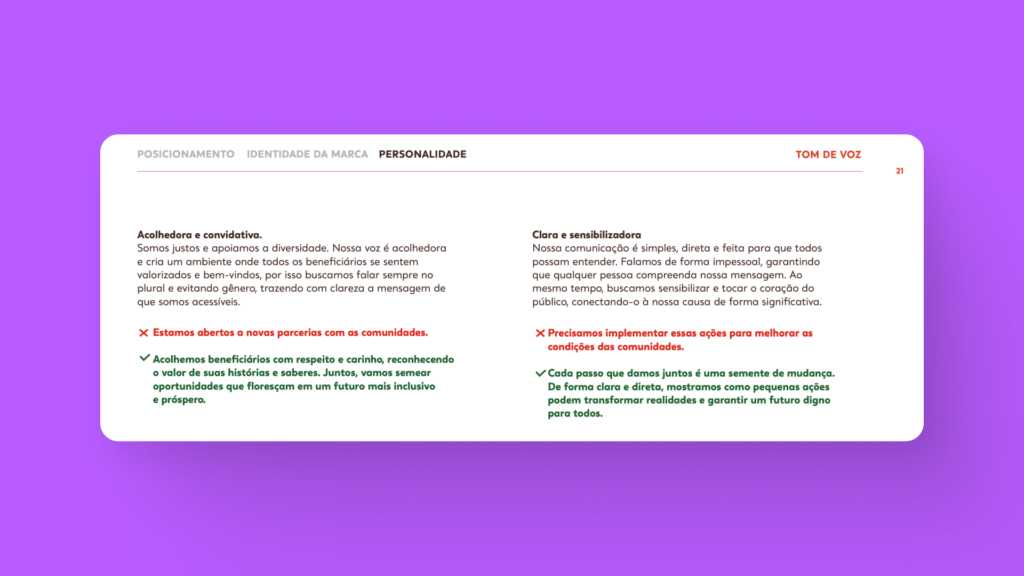
Technical vs. Accessible Language: How to Connect Your Cause with Your Audience
A common difficulty we encounter is the excessive use of technical or academic terms in communication. This often happens because the people behind the cause have spent years studying, discussing, and working within that specific field. In the search for the most accurate term, the message can sometimes become harder for a broader audience to understand.
Common challenge: Feeling that the organization is not truly connecting with its target audience, while also not wanting to compromise its expertise. This can lead to an attachment to specific terms and expressions that may not communicate clearly with the general public, including donors, supporters, volunteers, and other key audiences.
Tip: The key is to find balance. This can usually be addressed in two ways:
- By simplifying the concept as much as possible, using a more familiar, everyday term that still conveys the intended message.
- When a technical term is necessary and not widely known, make sure to educate the audience by immediately offering a translation or explanation.
Note: Be careful not to underestimate your community. In trying to reduce the use of technical language, there is a risk of making the communication feel overly informal.
Build an Impactful Narrative to Strengthen Credibility in the Nonprofit Sector
Some people still believe that branding is mainly about generating sales for a company. But even without a product on the shelf, your nonprofit delivers social impact, and for that impact to continue growing, your message needs clarity and focus.
Common challenge: A generic narrative that does not clearly differentiate the nonprofit from an outside perspective. Often, only those involved in the day-to-day operation fully understand the organization’s real impact. This makes it harder to mobilize civil society and to access support from large organizations and funders.
Tip: A well-built brand strategy helps communicate credibility, experience, and commitment. Funders look for reassurance, and a strong brand creates the trust needed for major partnerships to happen. Here are a few questions that can help assess whether your nonprofit’s differentiator is clear:
Is your target audience and field of work easy to find and understand across your channels? For example, if your organization focuses on socio-environmental issues, gender or racial inequality, or the preservation of Indigenous communities, is that information clearly visible on your website or social media bio?
What are the specific characteristics of your work? Years of experience? Reach and territorial presence? Professional development for the communities you serve? Number of supporters or scale of investment?
Note: Make sure that key proof points are available on your nonprofit’s website. This includes information such as the team involved in the operation and their credentials, as well as the impact the organization has already generated, including investment figures, projects, and the number of people benefited.
Strategic Visual Identity: Creating Elements That Strengthen Your Cause
Another essential pillar of cohesive communication is having a visual identity system that is strategically structured.
Common challenge: The nonprofit has a logo and a few brand colors, but the rest of its visual elements are created post by post, without following a clear system. Or, in some cases, there is a system, but it is too rigid, making every piece look the same and leaving little room for the flexibility required in day-to-day communication.
Tip: Do these colors make sense for our cause? Does our photography style value the communities we support, or does it reinforce stereotypes? Are the elements of our visual identity distinctive enough, or could they be confused with those of another nonprofit? Questions like these can help you understand whether your visual identity is strengthening or weakening your organization’s recognition.
No matter the size of your organization, a branding project can benefit small and medium-sized operations as much as large institutions. Want to see some examples of nonprofit branding in practice? Take a look at some of our projects:
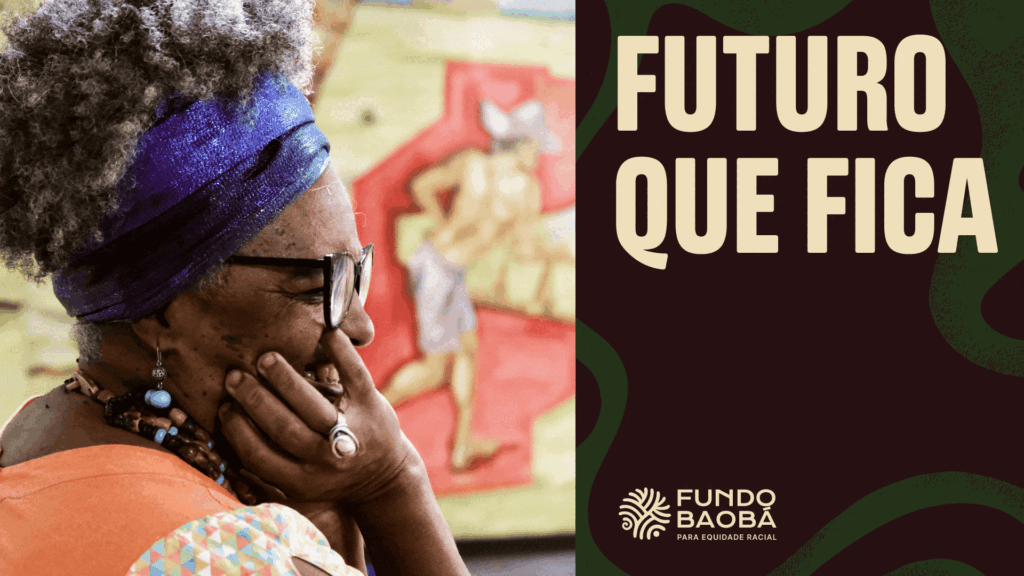
- Rebranding for Fundo Baobá, the first and largest endowment fund exclusively dedicated to promoting racial equity in Brazil.
- Rebranding for Fundo Casa, the first socio-environmental fund in South America.
- Brand and visual identity for GATC, the Global Alliance of Territorial Communities.
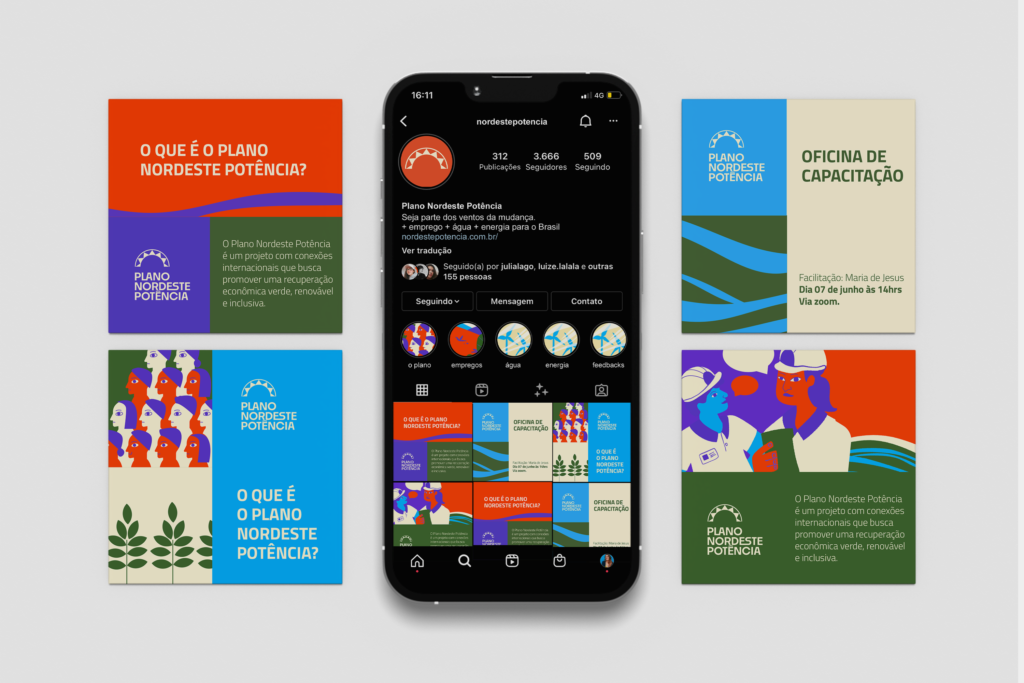
- Brand and visual identity for Iniciativa Nordeste Potência, an internationally connected project that seeks to promote a green, renewable, and inclusive economic recovery for Brazil.
If your nonprofit is looking to honor the richness of its work with an image and communication strategy that match the value of its social impact, get in touch with us. We can help.